What is a pressure gauge: operation, types and applications
A pressure gauge is an instrument used to measure the pressure of fluids and gases inside a closed system. Industrial pressure gauges are essential for monitoring and ensuring the safety of installations, allowing operators to verify that pressure remains within correct operating limits.
These instruments are used in many sectors, including the chemical industry, plant engineering, hydraulics, compressed air systems and gas distribution systems.
There are different types of instruments depending on the technology, the pressure range and what needs to be measured.
A bit of history
In 1644 Evangelista Torricelli conceived the principle of the barometer, building what is now called the Torricelli tube and identifying the Torricellian vacuum. Torricelli and Viviani demonstrated that a vacuum can exist in nature and that air has weight.
The unit preferred by European standards is the bar for countries using the metric system and psi for Anglo-Saxon countries. A pressure unit was named torr in Torricelli’s honor, while the International System unit is the Pa, named after another illustrious physicist, Pascal, who expanded and improved the theory of atmospheric pressure described by Torricelli.
The word barometer, coined by Boyle in 1667, is now almost always associated with Torricelli, who is therefore considered one of the most famous Italian scientists in the world.
Eugène Bourdon (Paris, April 8, 1808 – Paris, September 29, 1884) was a French engineer and watchmaker. In 1849 he invented the Bourdon pressure gauge, a pressure measuring instrument still widely used today.
At the time, the Bourdon gauge could measure pressures of hundreds of atmospheres, something previously unimaginable, and its introduction made a significant contribution to the safety of steam generators. To exploit the patent he founded the company Bourdon Sedeme.
What is a pressure gauge used for
Pressure is one of the fundamental parameters in industrial processes. Industrial pressure gauges allow operators to control and regulate the operation of systems and machinery, preventing operational anomalies.
Plant safety. Pressure monitoring is essential to prevent overpressure that could cause damage or dangerous situations, to verify that systems are under pressure (for example fire-fighting systems), to check whether machinery is operating (for example compressors), or to verify the correct sealing of a circuit (for example air conditioning systems).
For this reason, pressure gauges for industrial plants are fundamental components in safety systems.
Industrial process control. Pressure is often essential for the correct production of many products. Cement mortars, food pastes, adhesives and many other materials depend on pressure conditions.
Product quality therefore depends on proper pressure management, a key parameter in industrial production processes.
Applications
Industrial pressure gauges are used in many fields:
- compressed air (link https://www.bart-e.com/en/manometri/cassa-metallica.php)
- hydraulic systems (link https://www.bart-e.com/en/manometri/a-bagno-glicerina.php)
- gas systems (link https://www.bart-e.com/en/manometri/capsula.php)
- chemical industry (link https://www.bart-e.com/en/manometri/tutto-inox-atex.php)
- food industry (link https://www.bart-e.com/en/manometri/separatori.php)
- energy systems (link https://www.bart-e.com/en/manometri/digitali.php)
How a pressure gauge works
The operation of a pressure gauge is based on transforming fluid pressure into mechanical movement or an electronic signal.
In the most common industrial pressure gauges, pressure acts on an elastic element (such as a Bourdon tube or a diaphragm) which deforms proportionally to the applied pressure.
The movement generated by the deformation is transmitted to a pointer through a clockwork or gear mechanism that indicates the pressure value on a graduated scale.
Types of pressure gauges
Different types of pressure gauges are designed to adapt to specific operating conditions and pressure ranges.
Bourdon tube pressure gauges
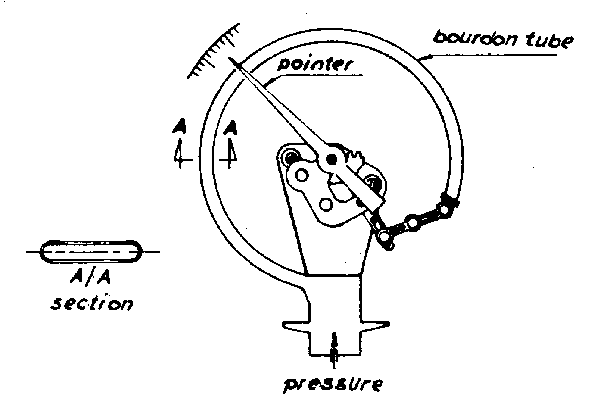
Bourdon tube gauges are the most widely used industrial pressure gauges.
Characteristics:
- wide pressure range
- robustness
- high reliability
They consist of a C-shaped or helical tube that tends to straighten when pressure is applied. The mechanical movement converts this elongation into pointer movement on the dial.
They are used in most industrial plants and technical applications.
This type is the most widespread thanks to its robustness, ease of reading, safety and wide range of selectable scales.
They can be made from different materials for use with different substances (see chemical compatibility table) and can be equipped with separators, electrical contacts, reference pointers and various connection types (see thread table).
They can also be filled with damping liquid (usually glycerin), which prevents pointer vibration caused by mechanical oscillations and protects the mechanism from pressure fluctuations and water hammer.
Diaphragm pressure gauges
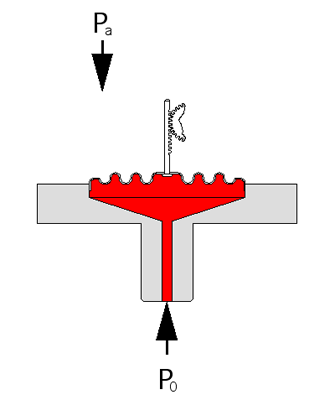
Diaphragm pressure gauges are used when it is necessary to measure low pressures or when the fluid may be aggressive or contaminated.
Typical applications:
- chemical industry
- filtration systems
- vacuum systems
These gauges have a gear movement directly connected to a diaphragm.
They do not cover a wide pressure range but are widely used for low pressures, also with glycerin filling or electrical contacts and where the process must be separated from the internal parts of the gauge.
They are often made of corrosion-resistant materials, becoming stainless steel gauges suitable for corrosive environments.
(see link https://www.bart-e.com/en/manometri/membrana.php)
Capsule pressure gauges
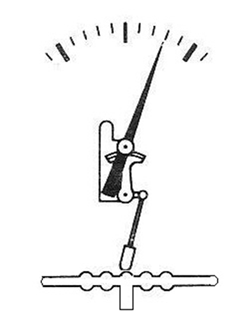
These are used for very low pressures, usually in methane gas systems, ventilation or open suction applications.
In this case the two diaphragms are connected to each other, creating a small “chamber” that expands or contracts.
This deformation is converted into rotational movement of the pointer on the dial.
Liquid column pressure gauges
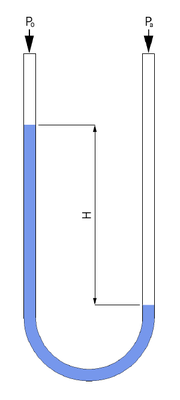
Liquid column gauges are used for very precise measurements, mainly in:
- laboratories
- calibration operations
- scientific applications
Although now less common, they are still among the most reliable instruments due to their simplicity.
They consist of a tube (usually transparent) bent in a U shape and filled with liquid.
One end of the tube is open to the atmosphere, while the other is connected directly to the process being measured.
The liquid height indicates the pressure on a graduated scale. See also the conversion table.
See our product sheet https://www.bart-e.com/en/manometri/particolari/Metal-U-manometer.php
Digital pressure gauges
Digital pressure gauges use electronic pressure sensors and offer:
- display reading
- high precision
- possibility of data recording
They are increasingly used in modern control systems because of their versatility and ability to integrate with process management software.
(see link https://www.bart-e.com/en/manometri/digitali.php)
Glycerin-filled pressure gauges
Bourdon and diaphragm pressure gauges can be filled with glycerin. Glycerin is a vegetable oil that acts as a damping fluid for the movement and the pointer.
Glycerin-filled gauges (see link https://www.bart-e.com/en/manometri/a-bagno-glicerina.php) can also be filled with silicone oil, which performs better at extreme temperatures.
Oil filling allows:
- reduction of pointer vibrations
- improved reading stability
- protection of the internal mechanism
For this reason they are widely used in industrial environments with vibrations, such as:
- compressors
- pumps
- hydraulic systems
Accessories
Pressure gauges can be equipped with electrical contacts (see link https://www.bart-e.com/en/manometri/contatti-elettrici.php) or diaphragm seals to prevent the process fluid from entering the elastic element and compromising its function (see link https://www.bart-e.com/en/manometri/separatori.php).
In addition, valves can be installed to isolate the gauge and protect it, or siphons to distance it from heat sources (see link https://www.bart-e.com/en/manometri/porta-manometri.php).
Components of a pressure gauge
An industrial pressure gauge consists of several key elements.
The case protects the internal components. It can be made of ABS, metal or stainless steel. Stainless steel cases generally provide sealed protection for outdoor or aggressive environments.
The elastic element which can be a Bourdon tube, helical tube, diaphragm or capsule that converts pressure into mechanical movement.
The movement mechanism which converts linear mechanical movement into rotational motion.
The dial, the graduated surface on which the pressure value is indicated.
The pointer, which indicates the pressure value on the scale.
The connection, which can be threaded, flanged or clamp-type and allows the pressure gauge to be connected to the system or piping.
How to choose the correct pressure gauge
Choosing the correct pressure gauge depends on several factors.
First: the measuring range.
In general, pressure gauges should not exceed 75% of full scale with static pressure and 60% of full scale with pulsating pressure.
Second: the operating environment.
For aggressive environments or chemical industries, stainless steel gauges are used, as well as in pharmaceutical and food industries. For other environments brass may be sufficient.
Third: how the pressure gauge is connected.
Connections are usually threaded: 1/8”, 1/4”, 3/8” (now becoming obsolete) and 1/2”, but they can also be flanged or clamp type.
The connection position may also vary:
- bottom connection (radial)
- back connection (rear)
- panel mounting
Panel mounting can be done with a three-hole flange, which allows front installation without accessing the back of the panel, or with a bracket, which has better aesthetics and occupies less space but must be installed from the rear.
Fourth: the size.
This depends on the available space and the distance from the operator.
The dial diameter influences readability: small gauges save space, while larger gauges are easier to read.
Common diameters are:
25, 40, 63, 80 (becoming obsolete), 100, 150, 200, 250 mm.
A 125/130 mm size existed but is now obsolete.
In case of vibrations or mechanical shocks it is better to use glycerin-filled pressure gauges.
Note: using a large glycerin-filled gauge only because it is far from the operator may not make sense; if it is distant, it can also be positioned away from vibration sources.
How to read a pressure gauge
The dial shows a graduated scale indicating pressure.
Reading tolerance, the number of notches, depends on the accuracy class and the type of pointer.
In precision gauges (primary reference gauges), the pointer has a knife-edge design and the dial includes an anti-parallax mirror to allow the most accurate reading.
Most gauges measure relative pressure, meaning the pressure inside a closed circuit without considering atmospheric pressure.
If atmospheric pressure is included, the instrument is called an absolute pressure gauge, which at rest starts at 1 (± atmospheric pressure) and where 0 represents absolute vacuum, measurable with specific gauges (see link https://www.bart-e.com/en/manometri/particolari/assoluto.php).
The most common units are BAR (preferred by EN 837) for metric countries and PSI for Anglo-Saxon countries.
The Pascal (Pa) was introduced with the International System in 1960 but, being very small, it is rarely used except in its multiples.
Pressure gauges are calibrated to be most accurate between 10% and 90% of full scale.
The accuracy class is expressed as a percentage of full scale. The result obtained is the maximum permissible error of the pressure gauge at any point above or below this range.
In the most common pressure gauges (Bourdon tube type), the measurement is derived from the deformation of a curved elastic tube.
The displacement of the tube’s tip is then converted into a rotation of the pointer.
The relationship between pressure → deformation → displacement is not perfectly linear. The scale can be ‘compressed’ or ‘expanded’ to improve readability by positioning the midpoint of the scale away from the exact centre of the pressure gauge.
Pressure gauge standards and regulations
Industrial pressure gauges must comply with specific technical standards and are referenced in several regulations.
The EN 837 standard defines the technical requirements for mechanical pressure gauges, including:
- construction characteristics
- safety
- accuracy classes
- measuring ranges
The accuracy class indicates tolerance with respect to the reference pressure, expressed as a percentage of the full scale value (or total span).
The result corresponds to the maximum permissible error.
Industrial applications of pressure gauges
Industrial pressure gauges are used in many sectors.
Pressure gauges for compressed air
Used in compressors and pneumatic networks to control air pressure.
Link https://www.bart-e.com/en/manometri/cassa-metallica.php
Pressure gauges for hydraulic systems
Used to monitor water pressure or other fluids in hydraulic circuits.
Link https://www.bart-e.com/en/manometri/a-bagno-glicerina.php
Pressure gauges for gas
Used in distribution and storage systems for technical and industrial gases.
Link https://www.bart-e.com/en/manometri/capsula.php
Pressure gauges for the chemical industry
In chemical environments, stainless steel pressure gauges or instruments with diaphragm seals are often used to withstand corrosive fluids.
Link https://www.bart-e.com/en/manometri/tutto-inox-atex.php
Digital pressure gauges
High precision and versatility
Link https://www.bart-e.com/en/manometri/digitali.php
Pressure recorders
Pressure gauges used to record pressure over time.
Link https://www.bart-e.com/en/manometri/registratori.php
Frequently asked questions about pressure gauges
What is the difference between a pressure gauge and a barometer
A pressure gauge measures the pressure of a fluid in a closed system, while a barometer or absolute pressure gauge measures atmospheric pressure.
How is a pressure gauge calibrated
Calibration is performed by comparing the instrument with a certified reference standard.
This check can be carried out by an ACCREDIA accredited laboratory (LAT) or directly by us with ACCREDIA traceability.
When should it be replaced
Industrial pressure gauges must be periodically checked and replaced if their accuracy no longer falls within the required tolerances.
How often should it be checked
You decide.
ISO 9001 states:
“When monitoring or measurement is used to verify the conformity of products and services to requirements, the organization shall determine and provide the resources needed to ensure valid and reliable results.”
In the case of a calibration certificate, the frequency is determined through risk assessment regarding the reliability of the instrument.
Verification and monitoring must be defined in each company’s procedures.
Two extreme examples:
A pressure gauge installed on a service van or workshop, used daily by different operators to test equipment and systems, is constantly exposed to risk. It should therefore be checked frequently.
Another case: someone purchases a gauge only to demonstrate system effectiveness when needed but never actually uses it. In that case it can be checked rarely.
The common practice is once per year, similar to certification body audits.
What certificates can I request
When talking about certificates, there are many possibilities.
Compliance with technical standards is the basic requirement and is usually available free of charge in the product sheet (example link https://www.bart-e.com/en/download/Dichiarazione_CE_Manometri_150.pdf).
If you need the declaration with your order reference or product code, it must be requested at the time of ordering. It is best to request all required certifications during the quotation stage: some may involve additional costs, while others may not be included in the regulations we follow.
Why is bar used?
Although the International System uses the Pascal, in technical practice (plants, pressure gauges, hydraulics and pneumatics) the bar is almost always used.
The reason is very simple: the Pascal is too small.
The relationship is an exact multiple of 10
1 bar = 100,000 Pa = 0.1 MPa
Typical example:
Atmospheric pressure ≈ 101,325 Pa
Writing it in Pascal is impractical.
Using bar it becomes:
Atmospheric pressure ≈ 1.013 bar
Much easier to read on instruments and diagrams.
In industrial instrumentation the bar is ideal for measurement scales:
- domestic water systems: 2–5 bar
- compressed air: 6–10 bar
- hydraulic systems: 10–200 bar
- hydraulics (oleodynamics): 200–400 bar
If Pascals were used, the scale would be much less readable on instruments.
Why is there an air bubble in the glycerine?
Glycerine (or other filling fluids), as mentioned, serves to dampen vibrations, protect the internal mechanism, and improve the readability of the dial. However, glycerine expands with temperature. If the pressure gauge were filled to 100%: when the temperature rises, the internal pressure would increase, which would cause measurement errors or even damage (deformation, leaks). The air bubble acts as a ‘compensation chamber’ for this expansion.
What rule is used for filling it?
There is no single ‘percentage’ that applies to all cases, but a well-established technical rule (standards + manufacturing practice) is followed, which is approximately 80–90% liquid with 10–20% air. This varies depending on the gauge’s diameter, the type of liquid (glycerine, silicone, etc.), and the expected temperature range.
The main standard is EN 837-1. It does not specify a precise percentage, but stipulates that the pressure gauge must ensure accuracy and safety, and that the filling must prevent internal overpressure caused by temperature
Therefore, the presence of the bubble is a necessary technical consequence of complying with the standard
Do i need to cut the cap off glycerine pressure gauges?
Temperature fluctuations affect the pressure inside the pressure gauge. Pressure increases in the heat and decreases in the cold, affecting the accuracy of the reading.
For glycerine pressure gauges with a full-scale range of less than 16 bar, it is therefore necessary to equalise the internal pressure by cutting, piercing or opening the rubber cap, with the cap facing upwards to prevent glycerine from leaking out.
For full-scale ranges exceeding 16 bar, the effect is negligible and the instrument can remain sealed.
If the temperature is stable, it is sufficient to temporarily open the cap to equalise the internal pressure, without piercing or cutting it.
Categories
Search product

ATEX 2014/34/EU Update
Receipt TÜV IT 23 ATEX 0122 AR

FEDERTEC
Did you know that Bart is part of the Assofluid - FEDERTEC family?
For us, this means staying up-to-date on regulatory, technical, economic, and legislative aspects, as well as tax and customs matters, throughout the entire supply chain.
For you, it's an ever-increasing guarantee of the quality, cutting-edge technology, safety, and reliability of our products.
Always on our customers' side, always one step ahead. Towards the future together.

Base chemical section of Milan Science museum.
BART has collaborated in a glass case in to section of the Basic Chemicals Leonardo da Vinci Museum in Milan
web site